Operators
Satellite operators
Unexplained interference on GEO links.
CelesGuard detects NGSO activity at strategic locations such as teleports and correlates interference events with specific satellites and constellations.

Full-sky NGSO spectrum monitoring.
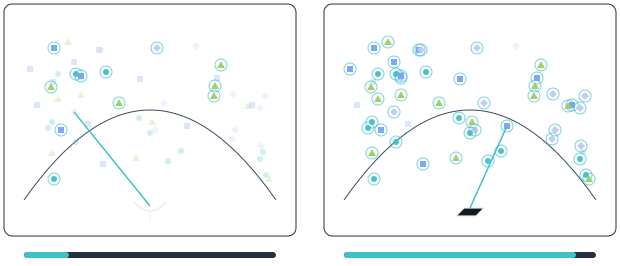
CelesGuard measures the activity of tens of NGSO satellites from multiple constellations at the same time, everywhere in the sky above 20° elevation.
01 · Audiences
Operators
Unexplained interference on GEO links.
CelesGuard detects NGSO activity at strategic locations such as teleports and correlates interference events with specific satellites and constellations.
Regulators
Constellations may exceed their licences or transmit too close to the geostationary arc without anyone noticing.
CelesGuard records how many satellites are active at any time and their contribution to EPFD limits.
Government
NGSO beams are narrow and intermittent, so unlicensed activity over a territory can go unseen.
CelesGuard detects constellations transmitting without authorisation.
Defence
CelesGuard determines whether user terminals are active in a given location.
02 · The difference
Conventional monitoring stations use parabolic antennas that take around ten seconds to re-point from one satellite to the next. When 50 to 100 NGSO satellites may be transmitting over a site at the same time, a dish sees only a fraction of the activity. CelesGuard uses electronically steerable antennas that switch between satellites with no moving parts, tracking several constellations at once across the whole sky above 20° elevation. Below that elevation, NGSO satellites do not transmit.
03 · Outputs
04 · Deployment
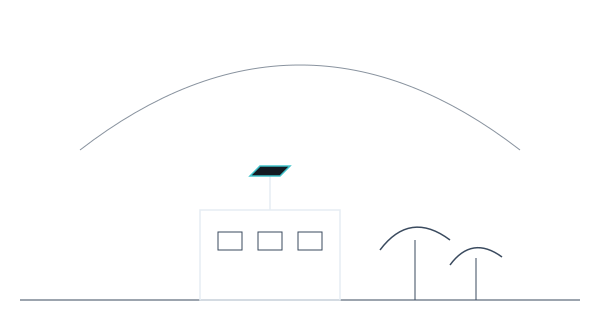
CelesGuard is a turnkey system, available as a fixed installation, a mobile unit, or a flyaway configuration packed in transport cases for remote locations.
05 · Specification